
EOR vs. Contractor: Choosing the Right Model for Your Global Team
A practical guide for U.S. companies hiring across borders
Hiring internationally gives companies access to people they might never find locally. But the way someone is hired needs to fit the way they actually work.
A genuine independent contractor may remain a contractor. Someone who is really working as an employee may be hired directly or, when the company doesn't have an entity in that country, through an Employer of Record (EOR).
The important part is getting the relationship right rather than simply reusing whatever hiring model worked last time.
It often starts with one great hire
A fast-growing SaaS company in San Francisco needs a product designer.
After weeks of searching, the strongest candidate happens to live in Toronto.
The company doesn't have a Canadian entity. Setting one up for a single person feels unnecessary, so the team brings her on as an independent contractor. She signs an agreement, invoices monthly and gets paid through Finance.
It works.
Then the company grows.
A developer in London joins. Two engineers in Spain follow. A customer success specialist comes on in Germany.
Eighteen months later, the team looks different.
The Toronto designer now reports to the VP of Product and joins the same weekly meetings as employees in San Francisco. The London developer has become part of the core product team. One of the engineers in Spain now works almost exclusively with the company.
Nothing dramatic happened.
The company grew, and some of those working relationships changed along with it.
Why this matters—and to whom
Global hiring isn't unusual anymore.
Deel's latest global hiring report draws on more than 1 million contracts from over 35,000 companies. That gives some sense of how routinely companies are now hiring people across borders.
As that becomes normal, more people inside the company become involved.
HR and People teams need to know whether someone should be hired as an employee or engaged as a contractor—and when that decision should be revisited.
Finance and Payroll need to know how people are being paid, what employment costs apply and what needs to be handled locally.
Founders and Operations leaders want to hire in new markets without having to invent a new process every time.
Compliance teams need the arrangement to reflect both the actual working relationship and the rules where the person works.
There's another reason this deserves attention now. In February 2026, the U.S. Department of Labor proposed another revision to the federal analysis used for independent-contractor status.
Rules change. Roles change too.
That makes periodically reviewing how people are engaged more useful than assuming the contract signed on day one will always reflect the relationship.
Does a contractor agreement make someone a contractor?
No—and that doesn't mean there's anything wrong with hiring contractors internationally.
Take a cybersecurity consultant hired for a four-month project.
They run their own business, work with several clients, decide how to deliver the work and have been brought in to produce a specific result.
That can look very different from someone who has worked inside the same company for several years, reports to the same manager and spends most of their working week with one organization.
In the United States, the IRS looks at what is actually happening in the relationship. Its guidance considers behavioral control, financial control and the type of relationship between the parties.
So the practical question isn't:
It's:
Can you use the same contractor model in every country?
Imagine a hiring manager messages HR:
It's a perfectly reasonable question.
But international hiring isn't usually that simple.
Canada has its own approach. The Canada Revenue Agency considers factors such as control, tools and equipment, subcontracting, financial risk and the opportunity for profit when looking at the working relationship.
The UK has its own employment-status framework.
Other countries have their own rules as well.
When should you take another look at a contractor relationship?
Go back to the Toronto designer.
When she joined, she had other clients, controlled her schedule and was responsible for a defined project.
Two years later, she attends Monday product meetings, reports to an executive and spends most of her week working on the company's products.
That doesn't automatically mean she's now an employee. Classification depends on the facts and the rules that apply where she works.
But it does give the company a reason to look at the arrangement again.
Five signs it may be worth reviewing the relationship
- The company increasingly controls how the work is performed.
- The engagement has moved from a defined project to an ongoing role.
- The person now works predominantly with one organization rather than operating independently across several clients.
- Their day-to-day work has become part of a permanent team or function.
- Nobody has reviewed the classification since they joined, even though the role has changed substantially.
Why getting worker classification right matters
Now imagine the San Francisco company has grown from 80 people to 350.
HR and Finance decide to look at the international team together.
They find 27 contractors across nine countries.
Some are clearly independent specialists working on short engagements. Others have been with the company for years.
At this point, nobody is questioning whether international hiring works. It obviously does.
The question is whether the way the company manages those relationships has kept up.
Classification can affect payroll, employment taxes, social contributions, statutory benefits, leave and other employment obligations.
In the U.S., the IRS notes that a business may be responsible for employment taxes when someone treated as an independent contractor should have been classified as an employee.
There is also a practical Finance issue.
As the number of countries and workers grows, Finance needs to know what people actually cost, how they're being paid and which obligations sit behind those payments.
What began as a handful of individual hiring decisions eventually needs some structure around it.
What if an employee moves to another country?
International hiring isn't the only way these questions arise.
Sometimes an existing employee tells their manager:
From the employee's perspective, very little may change.
Same manager. Same laptop. Same meetings.
For the company, the location has changed—and that can introduce payroll, employment-law and tax questions.
In November 2025, the OECD updated its Model Tax Convention with guidance addressing circumstances in which cross-border remote work, including working from a home office, can contribute to a taxable business presence.
That isn't a reason to discourage employees from moving.
It is a reason not to treat a move to another country as simply a change of address.
People can cross borders quickly. Payroll and employment arrangements sometimes need a little more preparation.
Contractor, direct employee or EOR?
There isn't one right model for every international hire.
A useful starting point is to look at the relationship you're trying to create.
| If the relationship looks like… | A model to consider |
|---|---|
| An independent business providing defined services | Contractor |
| An employee in a country where your company already has the appropriate entity and payroll setup | Direct employment |
| An employee in a country where your company doesn't have its own entity | Employer of Record (EOR) |
Consider the San Francisco company again.
It wants to hire a sales director in Germany.
This clearly isn't a consulting project. The person will own a market, report to the Chief Revenue Officer, manage company accounts and become a permanent part of the sales organization.
The company doesn't have a German entity.
It could establish one, particularly if Germany is becoming a major long-term market.
But the company may not want to build that infrastructure before hiring its first employee there.
That's where an Employer of Record can be useful.
An EOR can employ the person locally while the company continues to manage their day-to-day work and business responsibilities. The EOR acts as the legal employer and handles areas such as the local employment contract and payroll.
It doesn't make every legal, tax or operational responsibility disappear.
It gives the company another way to employ someone in a country where it doesn't yet have its own entity.

Where does Deel fit?
This is the point where Deel becomes relevant.
Not because every international worker should be put into the same arrangement, but because companies may need different ways to support different people.
A business might have genuine independent contractors in one country, employees hired directly through its own entity in another, and employees hired through an EOR somewhere else.
Deel supports several of those models, including contractor management, Contractor of Record and Employer of Record services.
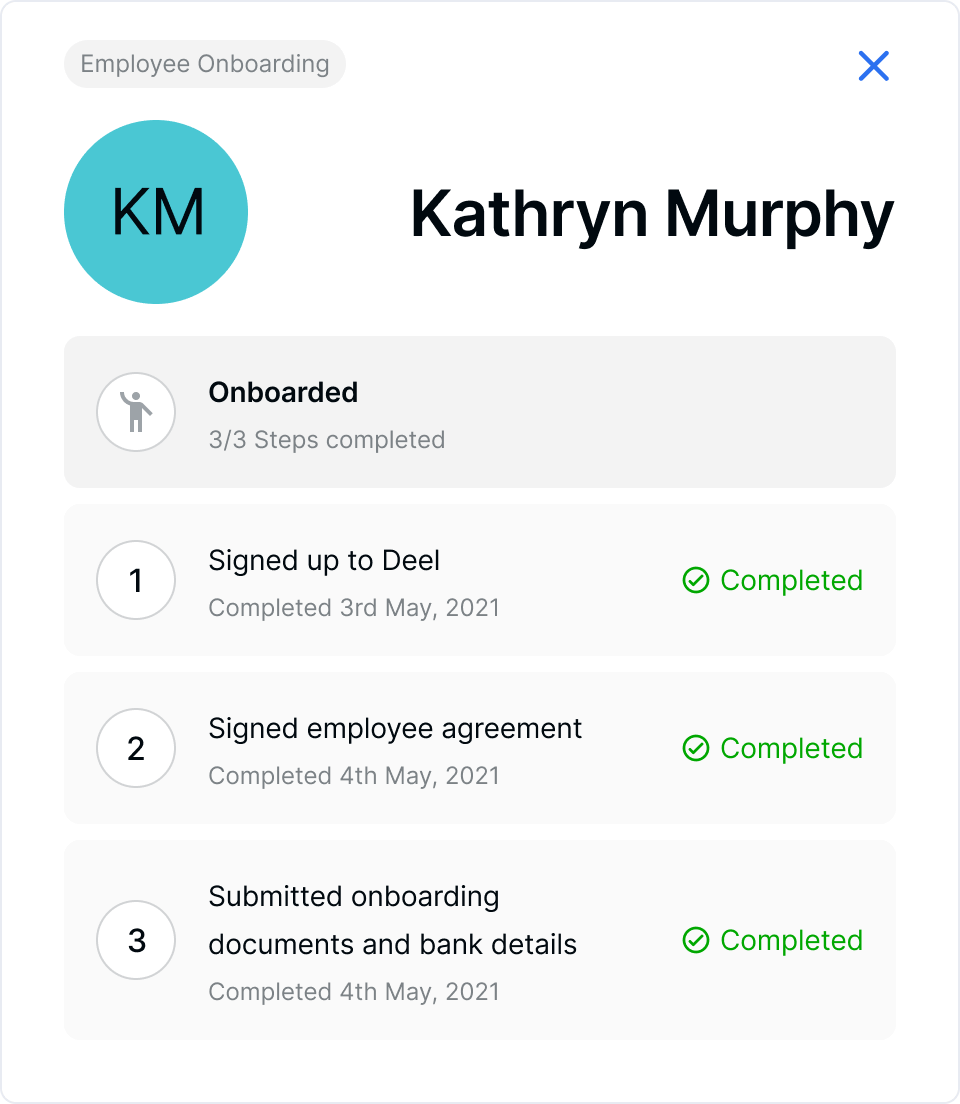
For HR and Finance, bringing more of that information together can also make some basic questions easier to answer:
Those questions become harder to answer when information is spread across local payroll providers, contracts, spreadsheets and individual managers.
The more countries a company adds, the more useful that visibility becomes.
Learn more about EOR and international hiring →Disclosure: PMWorld360 may receive compensation if you use our referral link. This does not affect our editorial analysis or recommendations.
5 questions to ask before your next global hire
- What will this person actually do?Start with the role and the real working relationship, not the contract you used for the last hire.
- Who will control how the work is performed?Think about what will happen day to day, not just what's written in the agreement.
- Are they genuinely operating an independent business?Consider their clients, business risk, independence and how they provide their services.
- What rules apply where they will actually work?Don't assume a model that works in the U.S. can simply be copied into another country.
- If this should be an employee role, how will we employ the person there?If your company doesn't have an entity in that country, an EOR may be one option worth considering.
Global hiring gets easier when the process grows with the team
The biggest advantage of international hiring is fairly simple: the right person doesn't always live near your office.
A company in San Francisco can hire a designer in Toronto, a developer in London or a sales leader in Germany.
The challenge isn't making every international hire fit the same model.
It's knowing which model fits the person you're actually hiring.
Start with the work.
Look at how the relationship will operate in practice.
Understand what applies where the person lives and works.
Then decide whether contractor, direct employment or EOR makes the most sense.
Do that consistently, and international hiring stops feeling like a series of exceptions.
It becomes part of how the company hires.
Disclosure: PMWorld360 may receive compensation if you use our referral link. This does not affect our editorial analysis or recommendations.