
Why Your B2B Software Isn't Making AI Buyer Shortlists
Your software may be missing from AI-generated buyer shortlists because it doesn't match the buyer's requirements, its product information is unclear, or independent sources don't provide enough evidence to support a recommendation. Results can also differ between ChatGPT, Gemini and other AI tools. At PMWorld360, we think the important question isn't whether your brand appears every time. It's whether buyers can find credible reasons to consider it when it's a good fit.
The short answer: absence has several possible causes
Imagine a 200-person consulting firm asking which CRM tools support role-based permissions and Microsoft integrations. Your product is missing. The missing recommendation could reflect product fit, unclear information or sources that have not caught up with the product.
Clear product information and relevant independent editorial coverage can work together to help buyers understand where your software is a good fit.
Research reinforces why this matters. In a March 2026 survey of 1,076 B2B software buyers and decision-makers, G2 reported that 54% identified AI chatbots as an influence on vendor shortlists. In a different, broad B2B sample, 6sense's 2026 Buyer Experience Report found that only 26% used LLMs to discover new vendors, and that the winning vendor was on the day-one shortlist in 92% of completed purchases. These are not competing measures of one population: they examine different buyer behaviors, questions and markets. Together they favor a balanced approach—build prior familiarity, accurate positioning and decision-ready proof as well as AI visibility. G2 research · 6sense research
Start with the questions buyers actually ask
The question matters. A broad search may favor familiar names, while a buyer with specific requirements may see a different shortlist. Mentioning your own brand in a question changes what the answer can tell you.
Broad category question
“What is the best CRM software?”
Broad questions often surface familiar names, but they say little about fit for a particular buyer.
A buyer question with specific requirements
“Which CRM tools suit a 200-person regulated consulting firm needing approval workflows, role-based access and Microsoft integrations?”
Specific requirements make the difference between a familiar name and a suitable choice.
These questions are illustrative, not results from AI-platform tests or evidence of any brand’s performance.
AI-assisted research spans ChatGPT, Gemini, Perplexity, Claude and Google AI Overviews. They do not all use or cite information in the same way, and no single answer represents a universal ranking.
Seven reasons your software may be missing from AI shortlists
We've organized seven warning signs to help you decide what to investigate first. Treat them as possible explanations, not a proven ranking system or a record of actual vendor results.
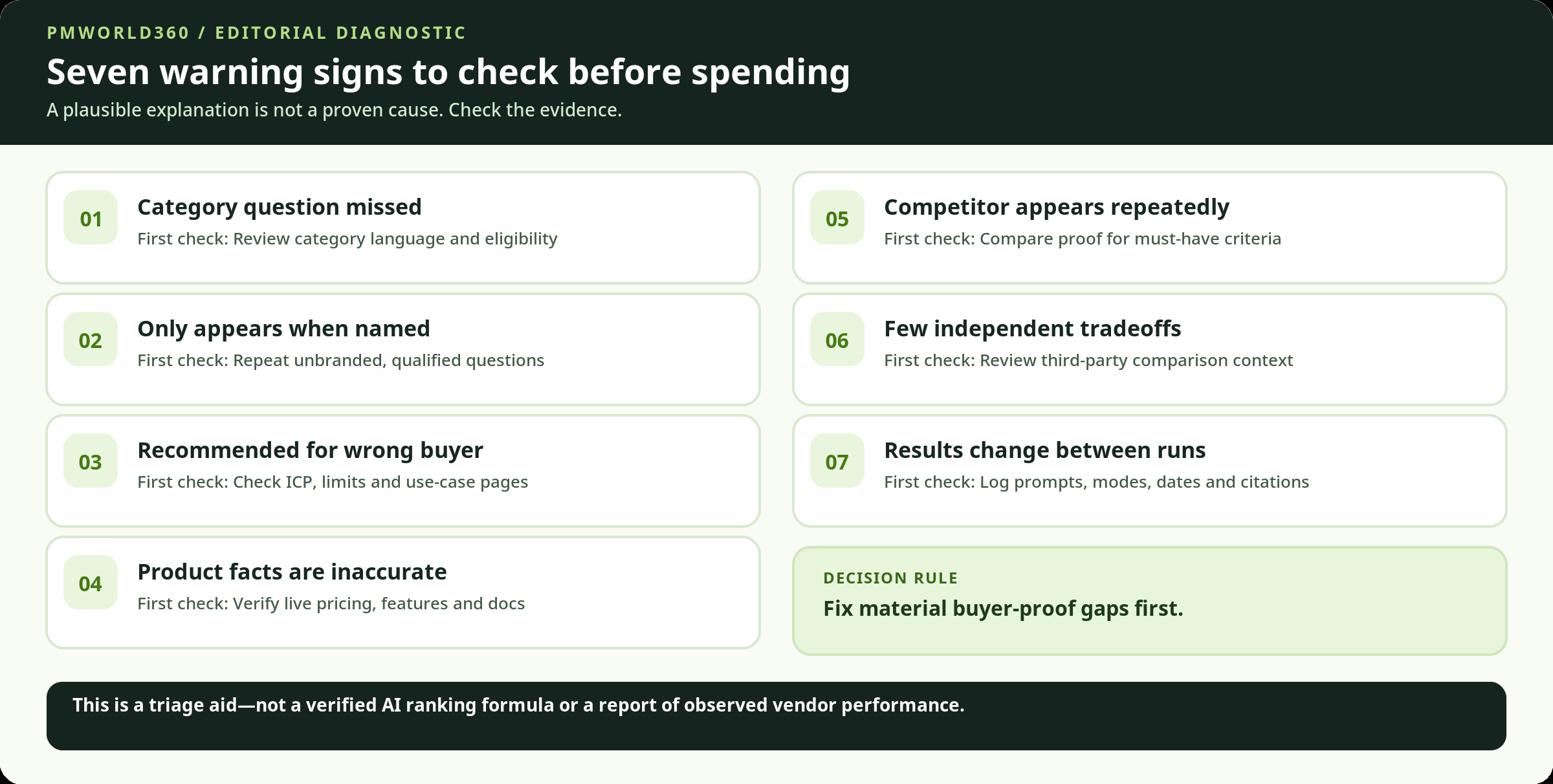
| Warning sign | Plausible explanation | First evidence check | What not to infer |
|---|---|---|---|
| Missing for an accurate category question | Category language may not clearly describe the product | Product category pages, schema consistency, actual competitive set | “The assistant has blacklisted us” |
| Mentioned only after the brand is named | Branded recognition may exceed unbranded relevance | Repeated questions about a specific buyer need without naming your brand | “Our brand is invisible everywhere” |
| Recommended for the wrong buyer | Positioning or public descriptions may overgeneralize fit | Ideal-customer profile, exclusions and segment pages | “Any mention is a recommendation that fits the buyer” |
| Inaccurate features, pricing or integrations | Accessible evidence may be outdated, unclear or inconsistent | Live documentation, release notes, packaging, citations | “The AI is solely to blame” |
| Strong competitor appears repeatedly | The competitor may be more familiar or better evidenced for that task | Proof available for each must-have criterion | “A competitor bought its way into the answer” |
| Few independent comparisons explain tradeoffs | Buyers may not have enough independent comparisons | Current reviews, comparisons, criteria and disclosures | “One sponsored post guarantees citations” |
| Results fluctuate between runs | Sampling, search mode, phrasing or retrieval can change | Repeated tests with consistent recording | “One screenshot proves a trend” |
We'd make accuracy the first priority. If an assistant repeatedly misstates whether your product suits a regulated workflow, check the official documents behind that claim. If the product genuinely doesn't meet the requirement, say so plainly. Better buyer guidance matters more than appearing in the wrong shortlist.
Want to take the discussion to your leadership team? PMWorld360's vendor white paper connects these questions worth investigating with product fit, buyer proof and commercial decisions.
Why AI recommendations can change from one search to the next
AI recommendations can change when a buyer asks a different question, uses another platform or searches at another time. That is why two people can see different shortlists without either result being a definitive ranking. Google also says AI Overviews and AI Mode need no special AI-only optimization. Google technical guidance
An AI mention is not the same as a suitable recommendation—or a business inquiry.
What to look into first
Focus first on information that could change a serious buyer’s decision, especially inaccurate claims about pricing, security or product suitability. A one-off omission from an unrelated question matters much less.
| Low buyer-effect on a buying decision | High buyer-effect on a buying decision | |
|---|---|---|
| Evidence is weak or outdated | Fix when convenient; keep a backlog | Investigate first: product facts, competitive evidence and suitability |
| Evidence is clear and current | Monitor representative questions, no emergency | Repeat tests; examine buyer intent, comparators and retrieval scope |
In our view, accurate pricing details, clear integration information and candid comparisons all help buyers understand where your software fits. Independent editorial coverage can add useful context when it addresses the questions buyers are asking.
Two illustrative scenarios: category mismatch versus missing proof
Scenario A: Poor fit. A lightweight project tool lacks the portfolio controls required by an enterprise PMO. That product may be a good choice for smaller teams, but not for this buyer.
Scenario B: Weak proof. A payroll platform serves the buyer’s countries, but its pages do not clearly distinguish native payroll, employer-of-record and partner coverage. Buyers may struggle to tell what is actually included.
We use these as illustrations, not client cases or measured tests. Sometimes the most useful outcome is helping a buyer rule out a product that isn't right for them.
Where independent reviews and comparisons can help
Your website is usually the best place for buyers to learn about your software’s features, pricing and capabilities. Independent reviews and comparisons can add another perspective, helping buyers understand where your product fits alongside other options.
That context can be useful whether someone discovers the article through traditional search, an AI assistant or another source.
At PMWorld360, we also consider sponsored editorial mentions when there’s a natural fit with the topic and our readers’ interests. Sponsored content is clearly disclosed, and we maintain editorial control over what we publish. Sponsorship doesn’t influence our independent ratings or recommendations, or guarantee search visibility, AI mentions or leads.
Learn About Editorial Mentions
08 What leaders should take away
For leadership teams, the priority is to distinguish a genuine buyer-information gap from a passing change in an AI answer. Clear product fit, accurate details and credible independent context make it easier for buyers to assess a product on its merits.
A useful leadership discussion is where uncertainty could affect a real buying decision—and which issues deserve attention now. Visibility alone is not the same as being a good choice for the buyer.
Frequently asked questions
Why do ChatGPT, Gemini or other AI tools mention competitors but not our software?
There is no single explanation. A competitor may be a better fit for the question, have clearer publicly available information, or simply appear in that response. AI-generated shortlists can change across platforms and questions.
Will independent articles guarantee an AI mention?
No. Independent articles can give buyers useful context, but publication does not guarantee that an AI platform will mention, cite or recommend a company.
Should we focus on AI assistants before Google SEO?
No. Strong SEO fundamentals still matter, including accessible pages, accurate product information and helpful content. AI visibility is worth considering alongside—not instead of—those basics.
Make one clear decision about what to improve first
A strong shortlist presence begins with clear, verifiable reasons a product belongs in the conversation. Prioritize information that helps buyers judge suitability, including limitations and realistic alternatives, before treating every missing AI mention as a visibility problem.
Editorial disclosure: PMWorld360's independent buyer research and conclusions are separate from its qualifying, clearly disclosed commercial editorial services. Sponsored relationships never determine independent ratings, rankings, comparisons or recommendations.
Sources and methodology
- G2, The Answer Economy: 2026 AI Search Insight Report — March 2026 software-buyer survey; population and measures remain specific to G2.
- 6sense, 2026 B2B Buyer Experience Report — cross-category B2B purchasing research; not a SaaS-only sample.
- OpenAI, Searching the web with ChatGPT — product help documentation.
- Google Search Central, AI features and your website — technical guidance on Google AI search features.
Research reviewed November 18, 2026. PMWorld360's tables, scenarios and recommendations in this article are interpretive frameworks, not independent empirical test results.