
The AI Hiring Stack in 2026: Recruiting, Screening, Compliance and Global Payroll
AI is making recruiting faster. But once the right candidate is found, your company still needs employment, compliance and payroll infrastructure that works where your new hire lives.
AI is moving into everyday hiring workflows. It can help define roles, source talent, organize applications, support screening and reduce recruiting administration.
But AI doesn't eliminate the harder questions that appear when the best candidate lives in another country. Someone still has to determine how that person can legally work for the company, which employment model applies, what contract is required and how payroll, tax and statutory benefits will be handled.
From our perspective, the most useful way to think about AI hiring in 2026 is simple: AI can accelerate the talent decision, but it doesn't replace the employment, compliance and payroll infrastructure needed to turn that decision into a real hire.
AI finds the right candidate. Then what?
Here's an example:
Imagine a U.S. software company needs a machine-learning engineer.
AI helps the recruiting team refine the job description, search a larger talent pool and organize incoming applications. A week later, the strongest candidate is in Germany.
That is a success for the recruiting stack—and the point where recruiting meets employment.
The company now needs an appropriate offer and employment agreement. It needs to know whether it can employ someone in Germany, what statutory requirements apply and how payroll, taxes and benefits will work.
That distinction matters. We are seeing hiring technology make candidate discovery faster and more global, but the infrastructure required to employ someone still has to catch up. For businesses, both sides of the workflow need to work together.
AI hiring is moving into the mainstream
SHRM's 2025 Talent Trends research reported that 43% of surveyed organizations were using AI to support HR tasks, up from 26% the previous year. Recruiting was the leading use case, including job-description generation, resume screening and candidate searches.
Nearly 90% of respondents using AI said it saved time and/or improved efficiency.
AI is also changing the talent companies are looking for. Deel's 2026 Global Hiring Report, based on more than one million worker contracts across 37,000+ companies in 150+ countries, found that general AI trainer roles grew 283% in cross-border hiring during 2025.
AI is impacting hiring from both directions: companies are using AI to recruit, while AI-related work is expanding the global talent market itself.
What does the AI hiring stack look like?
“AI hiring” isn't one tool making one decision. It's a connected workflow.
| Layer | AI can help with | What still needs governance |
|---|---|---|
| Job design | Descriptions, skills mapping, market research | Actual job requirements and fair criteria |
| Sourcing | Candidate discovery and matching | Search criteria, data use and fairness |
| Screening | Resume organization and qualification signals | Bias, validation, transparency and human review |
| Selection | Scheduling, summaries and decision support | Final judgment and accountability |
| Employment | Research and workflow automation | Classification, legal employer and local contracts |
| Payroll | Monitoring and anomaly detection | Correct pay, deductions, filings and controls |
We think this is the clearest way to separate the two sides of the stack. The first helps answer “Who should we hire?” The second has to answer “How do we employ and pay that person correctly where they work?”
Sourcing gets faster—and more global
Traditional sourcing is constrained by recruiter time. AI can search larger candidate pools, identify adjacent skills and surface people who may not use the exact keywords in the original search.
That makes geography less restrictive during candidate discovery. The best match might be across the globe rather than in the city where the company is headquartered.
Deel's global hiring data reflects the broader move toward cross-border talent. Its 2026 report says software developers represented 28% of cross-border hires among startups that raised $100 million or more.
That creates an important handoff:
Screening is where AI's efficiency and risk meet
AI can help recruiting teams manage hundreds or thousands of applications by extracting qualifications, organizing resumes and identifying candidates for review.
But screening influences who receives an employment opportunity. That means an AI screening system cannot be evaluated only by the recruiter hours it saves.
Questions HR should ask
- What employment decision does the system influence?
- What candidate data does it use?
- Are the signals genuinely related to the job?
- Can recruiters understand why someone was ranked or screened out?
- How is the system tested for discriminatory outcomes?
- Where is human review required?
In the United States, the EEOC has emphasized that existing employment anti-discrimination laws continue to apply when employers use AI and algorithmic tools.
For us, that is the important distinction: automation can change how a hiring decision is made, but it doesn't remove the employer's responsibility for the outcome.
Global AI hiring also means local AI rules
AI hiring requirements are not developing uniformly across markets.
The European Union's AI Act uses a risk-based regulatory framework and addresses certain employment and worker-management AI systems within its high-risk framework. Its implementation timeline continues to evolve as the EU phases in and adjusts different requirements.
For global employers, the practical point is more important than memorizing one regulatory date:
HR teams therefore need an inventory of the AI tools they use, the decisions each tool influences, the data involved, the jurisdictions touched and the person accountable for each workflow.
AI found the right candidate. Now how do you hire them?
Let’s go back to the machine-learning engineer in Germany.
The AI-assisted recruiting workflow has worked. The company found the right person and moved efficiently through selection.
Now the company needs answers to questions a candidate-ranking model was never designed to solve:
- Should this person be an employee or contractor?
- Does the company have an entity that can employ them?
- What must be included in the local employment agreement?
- Which statutory benefits and leave rules apply?
- How will payroll taxes and social contributions be handled?
- How will onboarding, compensation changes and eventual offboarding be administered?
This is the part of the AI hiring stack we think businesses can most easily underestimate. Recruiting technology can make talent feel location-independent. Employment law and payroll remain location-dependent.
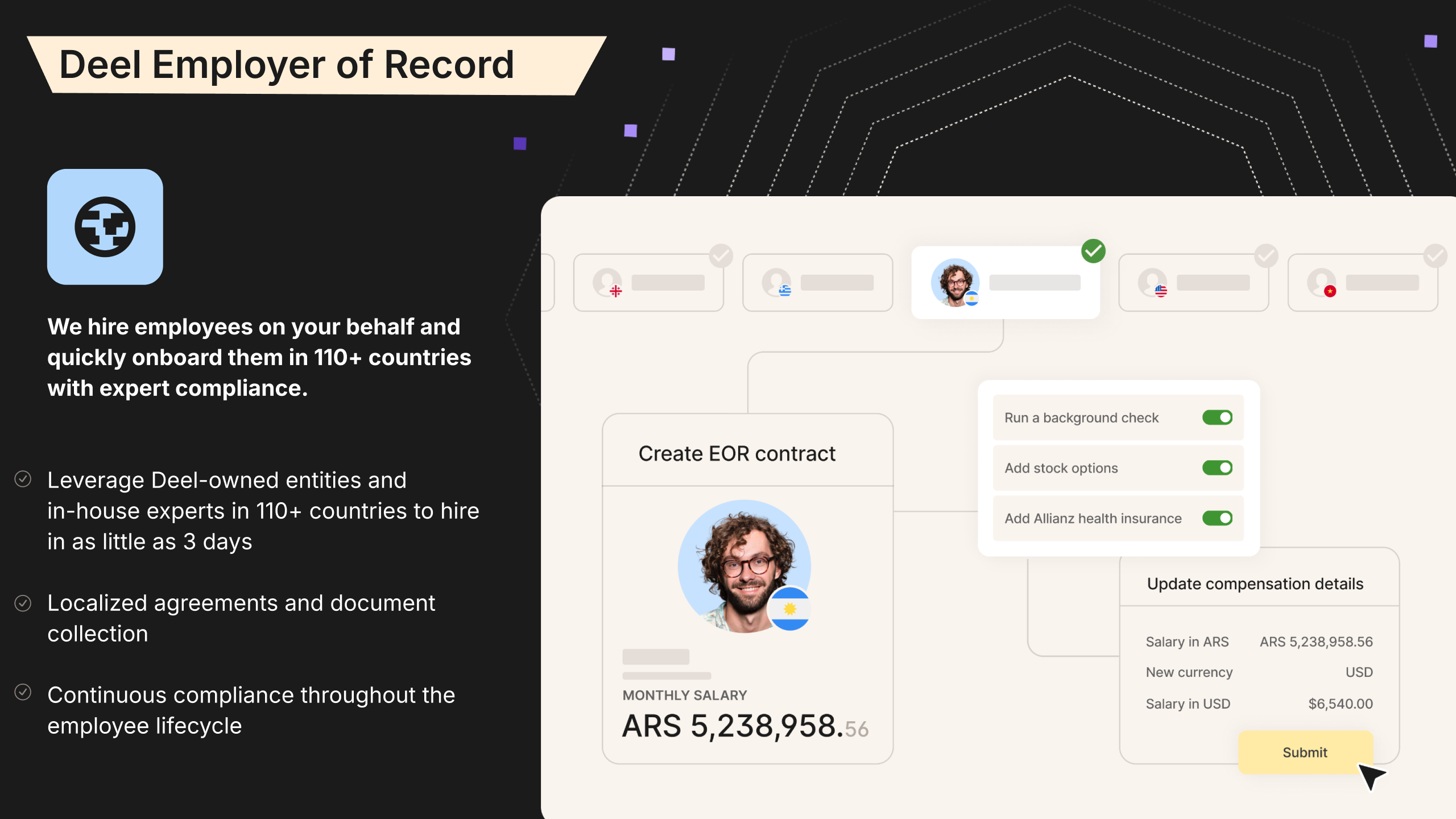
Where Deel fits in the global hiring process
As AI helps companies find talent across more markets, the next challenge is employing and paying those people correctly. This is where Deel fits into the workflow.
For companies hiring in countries where they do not have their own entity, Deel Employer of Record can serve as the local legal employer. Deel says its EOR supports hiring in 150+ countries and manages local employment contracts, payroll, statutory benefits and employment compliance.
Companies that already have their own entities can use Deel Payroll to manage payroll across countries, including local payroll requirements, filings and statutory obligations. Deel also provides tools for contractor management and worker classification.
The recruiting layer answers:
The employment infrastructure has to answer:
Disclosure: PMWorld360 may receive compensation if you use our referral link. This does not affect our editorial analysis or recommendations.
How Deel is using AI across hiring and payroll
Deel is bringing AI into more of the day-to-day work involved in hiring and managing a global workforce.
Its AI-powered applicant tracking system connects recruiting with workforce planning, onboarding, HR and payroll. For employers, the practical benefit is a smoother transition from choosing a candidate to bringing that person into the organization, with fewer disconnected steps along the way.
Deel is also developing specialized AI agents for HR and payroll tasks. Hiring Guru can help teams compare hiring markets and create compliant job postings, while Payroll Detective is designed to identify potential payroll issues before they affect employee paychecks.
For us, these are good examples of where AI can be genuinely useful in HR: helping teams find information faster, spot potential issues earlier and spend less time on repetitive work. But decisions with legal or financial consequences still need the right controls and human oversight.
What AI should—and should not—own
| Good AI-assisted task | Needs clear human ownership |
|---|---|
| Drafting job descriptions | Deciding required qualifications |
| Searching talent pools | Defining fair sourcing criteria |
| Organizing applications | Validating screening criteria and outcomes |
| Scheduling and summarizing interviews | Making the final hiring decision |
| Researching hiring markets | Approving compensation strategy |
| Flagging classification risks | Resolving ambiguous classification questions |
| Detecting payroll anomalies | Approving payroll and maintaining controls |
We do not think the dividing line is simply AI versus humans. A better test is whether the company has an accountable owner, appropriate controls and a clear point where automation stops and human review begins.
The biggest mistake is automating a fragmented process
From our perspective, this is one of the biggest mistakes businesses can make with AI hiring: buying excellent tools and automating a process that is still fragmented underneath.
Imagine sourcing is automated, resume review is faster and interview summaries arrive instantly—but nobody knows whether the selected candidate can legally be employed in their country.
The offer waits while Legal investigates. Finance searches for a payroll solution. HR discovers there is no local entity. The candidate receives several requests for the same information.
Nothing is necessarily wrong with the AI. The workflow around it is incomplete.
AI can find global talent. The right infrastructure helps you hire it.
AI can help companies understand the talent they need, search global markets, manage application volume and move candidates through recruiting more efficiently.
But when the selected candidate lives in another country, the workflow has to move from intelligence into infrastructure.
Someone must become the legal employer. The employment model has to be appropriate. A local contract may be required. Payroll must run correctly. Taxes, statutory contributions and benefits have to be handled. Local requirements continue after the employee starts.
In our view, that is Deel's most logical role in the AI hiring stack: the global employment, compliance and payroll layer that helps turn a borderless talent search into an operational workforce.
Disclosure: PMWorld360 may receive compensation if you use our referral link. This does not affect our editorial analysis or recommendations. AI, employment, privacy and payroll rules vary by jurisdiction and can change over time.
AI will change hiring. Accountability does not disappear with it.
For HR leaders in 2026, we think the more useful question is no longer whether AI belongs in hiring. It already does.
The better questions are where AI creates real leverage, where human judgment remains essential and whether the systems surrounding the hiring decision are ready for the speed AI creates.
Use AI to make recruiters better informed and less buried in repetitive work. Test systems that influence candidate opportunity. Know which rules apply where the technology is used. Keep people accountable for consequential employment decisions.
And when AI helps you find the right person halfway around the world, make sure your employment and payroll infrastructure can actually hire them.
Found the right global candidate with AI? Make the hire happen.
If you have a specific international employee in mind and want to compare the EOR route with building your own local employment infrastructure, the next useful step is to get a quote based on your hiring needs.
Get Custom Quote →Disclosure: PMWorld360 may receive compensation if you use our referral link. This does not affect our editorial analysis or recommendations.