
Why AI-Agent Developers Are Turning to Signal House for SMS and Voice
Building an AI agent is one thing. Giving it a practical way to communicate with customers through SMS and voice is another.
Explore Signal House →Building an artificial intelligence (AI) agent is one thing—giving it a practical way to communicate with customers is another.
An agent might be able to qualify a lead, schedule an appointment or answer a customer question, but it still needs a way to reach the person on the other end. For many businesses, that means SMS or voice.
That’s where Signal House is positioning itself.
Signal House describes its platform as built AI-first: a communications platform designed around developers creating AI agents, automations and AI-first applications. Its approach reflects how software is increasingly being built today—with AI coding tools, lightweight SDKs, webhooks and automated workflows.
The more important question for developers, vibe coders, marketers and businesses is whether the communications layer itself is built around the way AI-first applications are now being created.
Signal House is betting that the communications layer needs to change with the way these applications are being built. Its approach puts SMS and voice alongside AI-assisted development, agents and automated customer conversations rather than treating communications as something developers bolt on later.
Why Connecting AI Agents to Customers Gets Complicated
AI-assisted development can make it surprisingly fast to build an application or agent. Connecting that software reliably to customers can be a different challenge.
Developers still need to send and receive messages, process replies, connect those replies to an agent, navigate carrier requirements and handle growing messaging volumes without turning communications infrastructure into a separate project.
This is where Signal House’s positioning becomes relevant.
Its lightweight SDK is designed so AI development tools can read its types and work with the integration. In its AI-app integration guide, Signal House shows developers how to use Cursor or Lovable to work with the SDK and build an SMS integration from a prompt.
The platform also supports two-way messaging and webhooks, allowing customer replies to return to an agent or automation.
Signal House also says it supports SMS and voice within the same platform and provides hands-on assistance with A2P registration.
For developers, the practical question is whether that approach removes enough of the communications work that sits between an AI prototype and a customer-facing application.
Turning an AI Response Into a Customer Conversation
Traditional software might send an appointment reminder or order notification. An AI agent can potentially manage what happens next.
Imagine a prospect submitting a sales inquiry. An agent sends an SMS. The prospect responds. The agent interprets the answer, asks another question and moves the conversation toward an appointment.
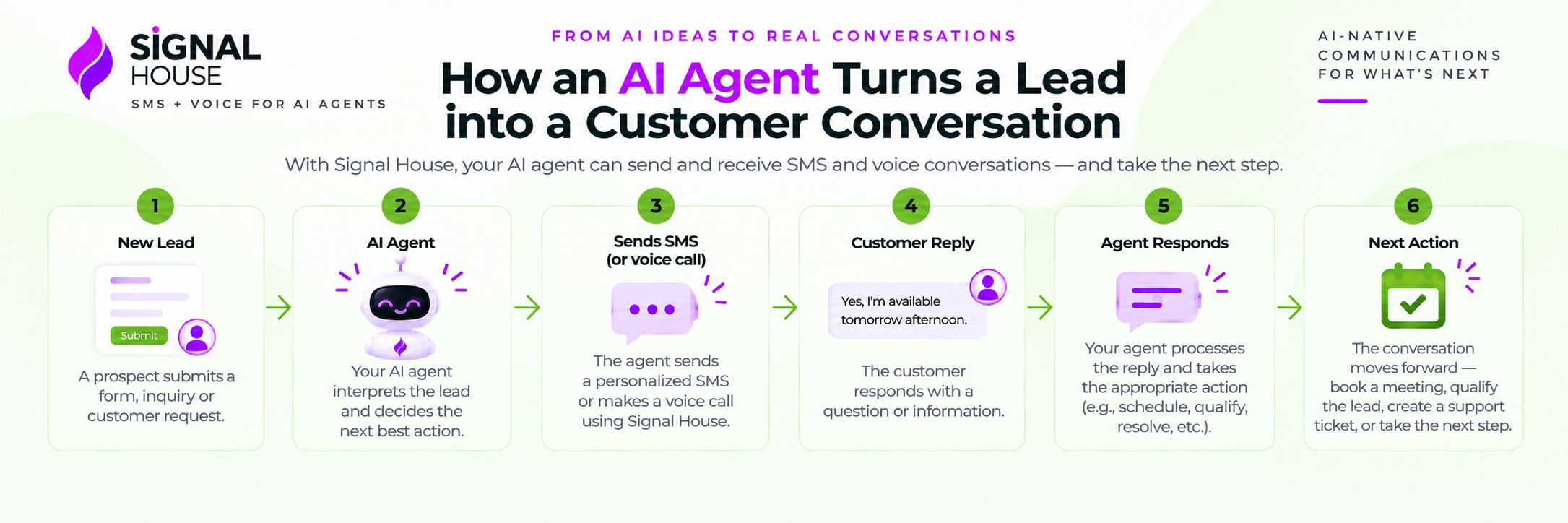
The same model can support lead qualification, sales follow-up, scheduling, confirmations, customer support and marketing conversations.
For developers, the question is no longer just “How do I send a message?”
It’s increasingly “How do I let my AI application participate in the conversation?”
Why AI-First Development Changes the Communications Layer
Communications APIs aren’t new. But the way software is being created is changing quickly.
Traditional communications platforms largely emerged when developers manually assembled applications around APIs, documentation and conventional development workflows.
Today, AI coding tools can help create applications, agents can make decisions and take actions, and automations can connect a customer response directly to the next step.
Signal House is positioning its communications layer around that shift. Its AI-agent guidance emphasizes an API and lightweight SDK that AI tools can work with, along with two-way messaging, webhooks, voice support and communications compliance.
For teams building this way, SMS and voice increasingly need to work as part of the broader AI application rather than as separate communications features added later.
Add SMS Without Slowing Down the AI Build
For developers using tools such as Cursor and Lovable, speed is part of the appeal of AI-assisted development. A communications integration that requires a completely separate development process can quickly become a bottleneck.
Signal House has designed its lightweight SDK around this newer workflow. Its developer guide describes a particularly lightweight path: get an API key, paste a prompt into Cursor or Lovable and let the AI editor work with the Signal House SDK to build the integration.
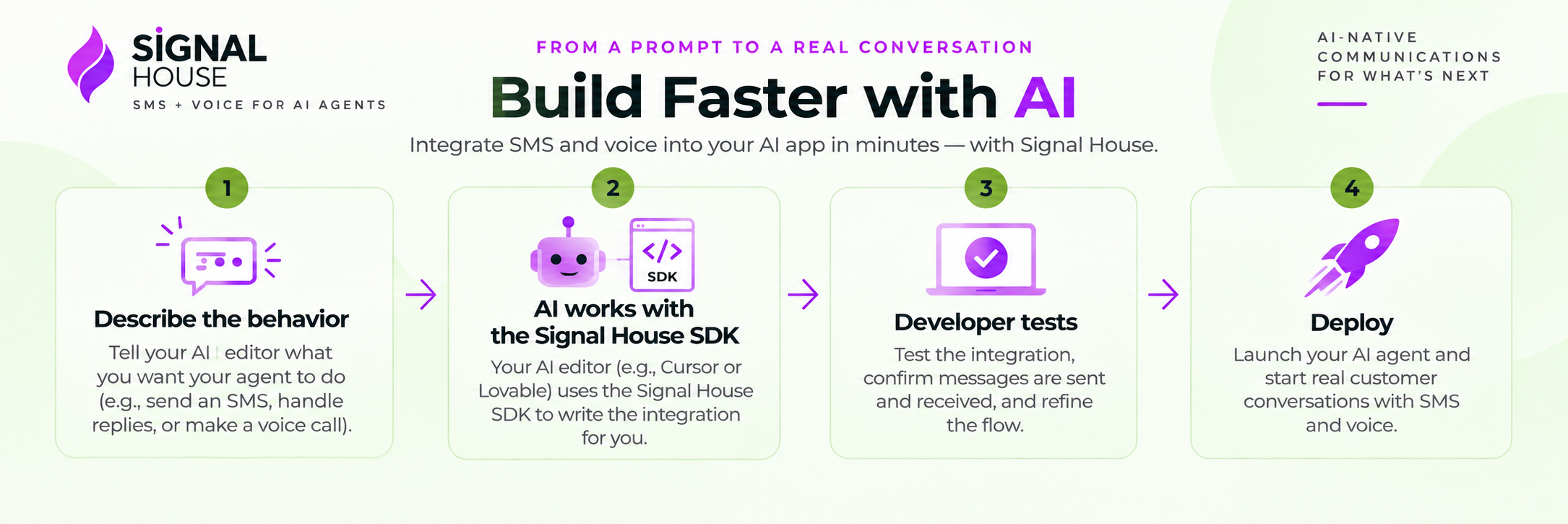
Signal House says developers can potentially send a first text in about ten minutes using this approach.
That doesn’t mean a production-ready application can be completed in ten minutes. Testing, security and proper configuration still matter.
But it does show how communications integration can become part of the AI-assisted development workflow rather than a separate development project.
Handling the Reply Is Just as Important
Sending an outbound message solves only half the problem.
If an agent asks a prospect whether they want to book a demo and the prospect replies, “Tomorrow afternoon,” something needs to happen with that response.
Signal House supports two-way messaging and webhooks, allowing incoming messages to return to the application so an agent or workflow can act on them.
A sales agent might continue qualification. An appointment agent could confirm a time. A support agent could respond or escalate an issue. A marketing workflow could determine its next action from what the customer actually says.
That ability to handle the reply is what turns SMS from a notification channel into part of an ongoing AI-driven customer interaction.
When AI Agents Need Voice, Not Just SMS
Not every customer conversation belongs in a text thread.
A lead may respond to an initial SMS but need a phone conversation before booking. An appointment agent may need to call with a confirmation or change. A customer interaction may simply be easier to resolve by voice.
Signal House says it supports voice alongside SMS, allowing developers to consider both channels as part of the same AI-agent strategy.
For developers building agents that may need to text in one situation and use voice in another, having both available within the same broader communications platform can reduce the need to assemble separate infrastructure as the application evolves.
From AI Prototype to Production: Navigating A2P
A working AI prototype doesn’t automatically mean a business can start sending SMS at scale.
Businesses using AI agents for application-to-person SMS in the U.S. need to account for A2P/10DLC registration when sending over 10-digit long-code numbers.
For developers unfamiliar with carrier requirements, compliance can become an unexpected hurdle between a working application and an actual launch.
Signal House says it helps customers through the registration process rather than leaving them to navigate it alone. Its AI-agent guidance says A2P registration is often approved in about 48 hours, with pay-as-you-go registration within 72 hours. These are Signal House’s published timelines, not guaranteed carrier approval times.
For developers who know how to build an AI agent but don’t want to become telecom compliance specialists, that implementation support can remove an important source of friction.
Independent customer evidence exists for the support experience. Verified G2 reviews discuss hands-on help with setup, A2P registration and customer support.
Can It Handle High-Volume AI Messaging?
An AI agent can potentially participate in far more conversations than a human team. As those interactions grow, throughput, deliverability and cost become increasingly important.
Signal House targets high-throughput messaging and reports 99%+ delivery through carrier-direct routing. This is a Signal House-reported figure rather than an independent PMWorld360 measurement, and actual results can vary.
An AI agent’s response creates little value if the customer never receives it.
Cost also changes as usage grows. Signal House publishes volume-based messaging rates and carrier fees, giving prospective customers a way to model communications costs as usage increases.
The company states that rates can be negotiated based on volume and agreement terms.
That transparency is important for AI-agent teams because successful automation can cause messaging volume to increase quickly. Buyers can examine the likely communications cost earlier rather than waiting until usage has already scaled.
There’s also third-party evidence worth considering. At the time of writing, Signal House has more than 200 reviews on G2 and an overall rating of 4.8 out of 5. Verified customer reviews discuss setup, A2P registration, customer support, reliability and high-volume messaging.
Individual experiences naturally vary, but that feedback provides useful context beyond Signal House’s own positioning.
Who Is Signal House For?
Signal House is most relevant when communications are an important part of what an AI application actually does.
That includes developers building agents that need to send and receive SMS, founders and vibe coders working in Cursor or Lovable, marketers and sales teams automating lead follow-up, businesses sending high volumes of messages, and teams building agents that may need both messaging and voice.
Industries and Use Cases
Its use cases also span SaaS, marketing agencies, e-commerce, financial services, healthcare, real estate and other customer-facing industries.
Signal House’s customer stories provide examples of businesses using its communications platform in practice.
The common problem isn’t simply needing an SMS API.
It’s needing a communications layer that can keep up with the way an AI-powered application is built, how it interacts with customers and how quickly usage can grow.
Building an AI Agent That Needs SMS or Voice?
Signal House is worth evaluating early when two-way conversations, AI-assisted development, messaging at scale or hands-on implementation support are part of the requirements.
Explore Signal House for Your AI Agent → Affiliate link — PMWorld360 may earn compensation at no additional cost to you.Its combination of an AI-oriented developer workflow, two-way messaging, SMS and voice, published pricing, A2P support and high-volume infrastructure addresses several of the problems that can appear between a working AI prototype and a customer-facing application.
Developers, vibe coders, marketers and businesses can review Signal House’s AI-agent resources to determine whether the platform fits their application, expected communications volume and customer interaction requirements.